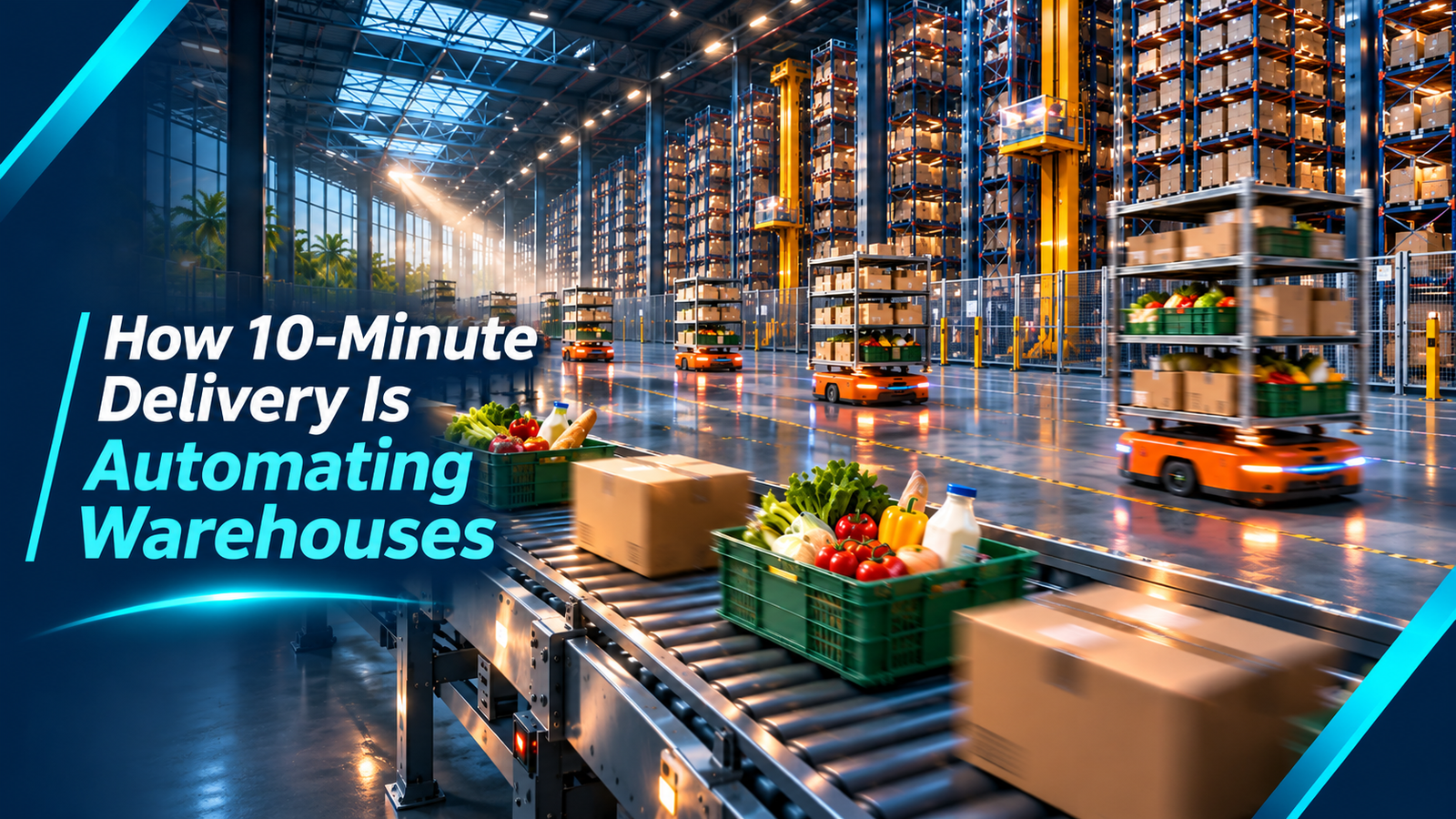
Warehouse automation India is getting a push from an unlikely place: 10-minute grocery delivery. Quick commerce companies need to move huge volumes very fast, and that is changing how Indian logistics invests in conveyors, sorters, software and robots.
This guide explains where the automation actually sits, what is still done by hand, and what the market numbers say.
How Big Warehouse Automation India Has Become
Frost and Sullivan projects India’s warehouse automation market to grow from $422 million in 2023 to more than $1.6 billion by 2030, according to a May 2026 analysis. It says roughly seven in ten companies are now exploring automation, compared with about three in ten before the pandemic.
The same analysis calls quick commerce the most aggressive source of demand, with third-party logistics firms and retail and e-commerce players the largest buyers overall.
Two Very Different Kinds of Warehouse
Quick commerce runs on two layers, and they are automated very differently.
- Large distribution centres feed stock into the city. This is where heavy automation goes: conveyors, sorters and automated storage.
- Dark stores are small neighbourhood warehouses that pack individual orders. Most are still largely manual.
Business Today counted about 6,563 dark stores in India in early 2026, including Blinkit’s 2,027, Swiggy Instamart’s 1,136 across 131 cities, just over 1,000 for Zepto, 800 plus for BigBasket and 600 plus for Flipkart Minutes. At one BigBasket store it visited, staff picked and packed orders by hand into paper bags across three shifts.
Inside an Automated Quick Commerce Supply Chain
Zepto gave one of the clearest public descriptions at the India AI Impact Summit in February 2026, as reported by Digit. The company said:
- More than half of its order volume runs through highly automated distribution centres.
- These sites use cross-docking, automated storage and retrieval, linear sorters, conveyors, pick-to-light systems and high-speed sorting and packing machines.
- Machine learning decides where each product is stored, how pickers are routed and how tasks are assigned.
- Average packing time is about 60 seconds per order.
- Forecasting models predict demand at the neighbourhood level, so the right stock sits in the right dark store.
In other words, much of the automation in quick commerce is software. Forecasting, slotting and routing decide whether a 10-minute promise is possible long before any robot moves a box.
Why Companies Are Investing Now
The growth runway is long. Inc42 reported that operators were expected to add roughly 2,000 to 2,500 new dark stores in 2026, and Blinkit’s parent Eternal has guided for 3,000 stores by March 2027. More stores need more replenishment, which puts pressure on the distribution centres behind them.
Frost and Sullivan also expects growth in autonomous mobile robots, shuttle systems, goods-to-person systems and micro-fulfilment centres, plus AI tools for real-time visibility. Indian vendors such as Addverb and Falcon Autotech compete with global suppliers for this work, and our humanoid robotics article covers Addverb’s other plans.
The Catch: Automation Can Fail Too
- Many small and mid-sized firms lack long-term demand visibility and end up buying undersized systems.
- Poor material flow design can cause up to a two-times difference in productivity between similar facilities.
- Buying technology before fixing the process is a common reason projects disappoint.
- Local engineering, fast service and spare parts are now basic requirements, not extras.
These points come from the same Frost and Sullivan analysis, and they are a useful checklist for any business considering automation.
For a small business, warehouse automation India vendors increasingly offer modular options, such as a few mobile robots or a pick-to-light zone, instead of a full automated building. Starting small and measuring results is usually safer than a single large purchase.
What It Means for Jobs
Quick commerce still employs large numbers of pickers, packers and delivery riders, and dark stores remain people-heavy. A Kearney estimate cited by Business Today found quick commerce creates more jobs per crore of monthly sales than modern trade or e-commerce. Automation so far is concentrating in the bigger hubs rather than replacing neighbourhood store staff.
This article reflects publicly reported information as of 28 November 2026. Store counts change quickly.
Sources and further reading
- Warehouse automation in India: from experimentation to structured adoption, Frost and Sullivan
- Quick commerce firms go big on dark stores, Business Today
- Zepto details its AI-led quick commerce operations, Digit
- Is quick commerce set to enter its most competitive phase in 2026?, Inc42