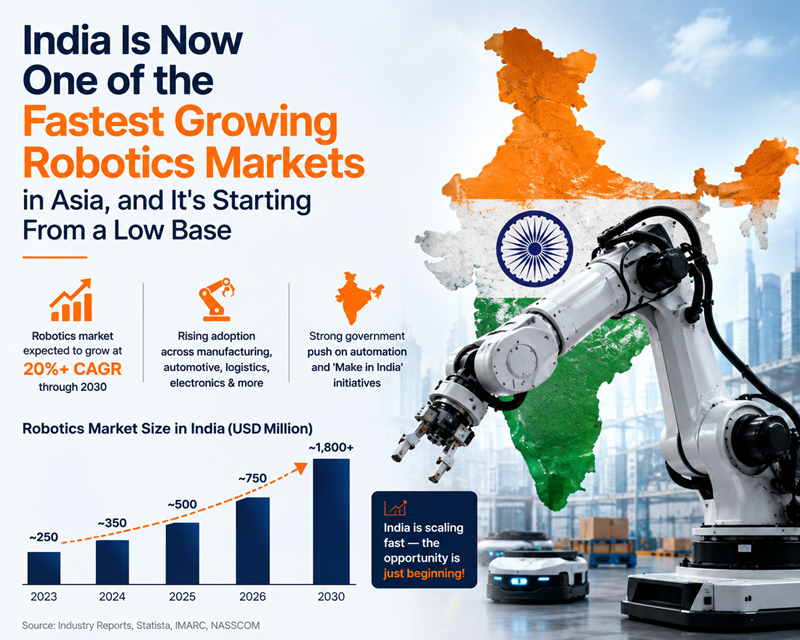
The industrial robotics India market is growing faster than almost any other major economy in Asia right now, though it’s important to understand exactly what that growth is starting from.
The Growth Story
Multiple market research estimates converge on a similar picture: India’s industrial robotics and automation market is expanding at somewhere between 11 and 16 percent annually, depending on which segment you’re measuring, with the broader industrial automation market projected to grow from around 3.6 billion dollars in 2025 to over 13 billion dollars by 2034. One analysis puts India’s current year over year robotics market growth as high as 34 percent, among the fastest of any major robotics market in the region.
According to the International Federation of Robotics, India installed a record 9,100 industrial robots in 2024 alone, a 7 percent increase from the previous year, making it the sixth largest installer of industrial robots in the world that year.
The Low Base Behind the Big Percentages
Here’s the context that matters: India’s robot density, meaning the number of robots per 10,000 manufacturing workers, remains low by global standards. Estimates place it somewhere between 12 and 67 robots per 10,000 workers depending on the source and methodology, compared to over 415 in South Korea, the world’s most automated manufacturing economy. That gap is exactly why growth rates look so dramatic. India is automating quickly, but from a starting point with enormous room left to grow.
Where the Investment Is Concentrated
The automotive and EV manufacturing sector remains the single largest driver of automation demand in India, unsurprising given the EV sales boom covered elsewhere on this site. In 2023, the automotive industry alone installed 3,551 robots, up 139 percent from the year before, largely to support EV platform assembly, battery manufacturing, and precision component production.
Beyond automotive, pharmaceuticals and medical devices are automating quickly to meet FDA and WHO GMP compliance requirements. Electronics and semiconductor manufacturing is another major growth segment, driven in large part by Production Linked Incentive scheme funded expansion of mobile phone assembly and semiconductor facilities. Maharashtra, particularly the Mumbai and Pune corridor, has emerged as one of India’s most advanced industrial automation hubs, thanks to its concentration of automotive, pharmaceutical, and electronics manufacturers.
Government Money Is a Real Factor Here
The Production Linked Incentive scheme has approved 755 applications and attracted over 1.23 lakh crore rupees in investment. In 2024 specifically, the government provided 4,500 crore rupees in incentives to roughly 2,000 companies implementing robotic systems, a direct and fairly sizable subsidy pushing manufacturers toward automation faster than market forces alone likely would.
The Bigger Global Context
Part of what’s accelerating Indian manufacturing automation is the broader “China plus one” supply chain shift, as global manufacturers diversify production away from being entirely China dependent. Companies including Apple, Samsung, and Foxconn have collectively committed over 10 billion dollars to Indian manufacturing capacity, and much of that investment is going into new, greenfield factories built to modern automation standards from day one rather than older facilities being retrofitted.
The Takeaway
India’s industrial automation growth is real and well funded, but it’s a story about closing a large gap rather than an already mature market accelerating further. For robotics component suppliers, systems integrators, and automation talent in India, that gap is effectively the size of the opportunity still on the table over the next several years.